Showing posts with label read. Show all posts

Women of Art History: Frances

Frances Benjamin Johnston. 1864-1952. America.
Photographer.

How many artists can you name? Chances are, you'll have named many more men than women. From the moment we are children, most of the artists and artworks we are exposed to are created by or about men. It's time to rebalance the scales and open up the artistic 'canon', introducing more women and ethnic minorities into the widely known narrative of art history. Here, I'll be trying to do just that in the style of a children's story, introducing you to one more woman from art and art history who, until now, you might not have known. 


Once upon a time, there was a little girl called Frances. She grew up in Washington DC and studied art. She became a very clever young woman and wrote a lot of articles. One day, Frances was given a camera by a family friend and she realised her true passion.

Frances began taking photographs of friends and family and practiced photography until she could set up her own photography studio. In 1894, she finally opened her studio as the only woman photographer in the whole city!

Add caption

Frances’ reputation began to spread and celebrities started wanting her to take their portraits! In the Victorian times, you couldn’t just take a selfie on your phone. Having your photo taken was really special, and cost a lot of money. Very rich people came to Frances for their official portraits which they would hang in their houses. Frances took photos of Mark Twain, a very famous writer and Booker T Washington, a very important African-American politician. Unlike other old photographs which are sometimes quite formal and boring to look at, Frances’ photos really caught the expressions and personalities of the people in front of her.

Booker T Washington, Frances Benjamin Johnston, 1895


Image result for Mark Twain by Frances Benjamin Johnston
Mark Twain, Frances Benjamin Johnston, 1906

Frances took a photograph of Susan B Anthony who was an important women’s rights activist who also fought for the end of slavery. Frances' photo captured how strong and determined Susan had to be to be an activist for women at a time when women were not seen as equal to men. Susan even looks a bit scary in the photo, because she looks so powerful!
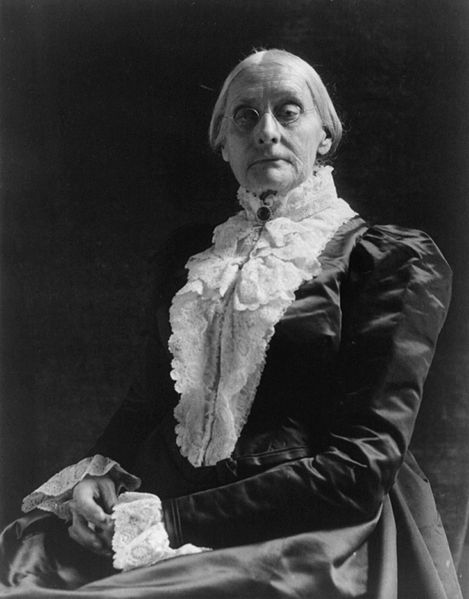

File:Susan B. Anthony by Frances Benjamin Johnston.jpg
Susan B Anthony, Frances Benjamin Johnston, 1900
Frances was so successful that she was appointed to be the official White House photographer which meant she took the portraits of all the Presidents. She took the official portraits of President Harrison, President Cleveland, President McKinley, President Roosevelt and President Taft. That’s a lot of Presidents! 

Even though there were no other women in the room, and all the polticians involved were men, Frances was employed to photograph major moments in American politics. She captured the moment peace was signed between America and Spain in 1898.

Signing of the Protocol, Frances Benjamin Johnston, 1898

Frances also took photos of architecture and buildings. But her photographs were special because, unlike other American photographers, she wasn’t drawn to the modern buildings and new developments. She took photos of old, dilapidated buildings, historical structures that were falling down or were going to be demolished. She wanted to capture them just before they were knocked down. 


Lots of people began to realise how important it was to document buildings before they were destroyed or collapsed. She began to be employed all over America to take photographs and record historical architecture.

Add caption

Not only was Frances great at taking other people’s photographs but she took photos of herself too. These are known as self-portraits and they were really interesting.  She took a photo of herself as a New Woman which was what modern women were called in the Victorian times. They were women who didn’t want to be controlled by men their whole lives. People thought Frances looked like a man in the portrait because she was leaning forward as if she was having a conversation. Women were normally shown as being very quiet, but Frances was showing she had a lot to say. She also lifted up her skirt to show her ankles which was really shocking! She did another portrait where she looked like a more traditional Victorian woman, dressed up in fur. Frances was showing women could be both: powerful and fashionable, they could talk and be modest. They didn’t need to be confined by rules of how they should look!

Frances Benjamin Johnston, Self-Portrait (as "New Woman"), 1896.jpg
Self Portrait as a New Woman, Frances Benjamin Johnston, 1896

Frances also supported other women who might want to become photographers. She knew the camera could be a powerful way for young women to create success for themselves. In 1897, she published an article called ‘What a Woman Can Do With a Camera.’  In it, she said that even women from poorer backgrounds could achieve success with enough passion and commitment. She said hard work would always help ‘develop small beginnings into large results.’

Image result for frances benjamin johnston self portrait
Self Portrait, Frances Benjamin Johnston, 1896
Even though Frances was well known during her life, in the following centuries, her photographs have not been as famous. It is important we remember Frances for the work she did to promote female photographers and support the success of other women.

Just like the old buildings that so fascinated her, Frances bought one of the oldest houses in the oldest area of New Orleans. She lived happily ever after for the rest of her life in a beautiful historical building, surrounded by photographs.

Frances' house is New Orleans
You May Also Like...
http://lifeofanarthistorystudent.blogspot.com/2018/09/women-of-art-history-lubaina.html

0

Women of Art History: Lubaina


Lubaina Himid. 1954-. Britain 
Artist and activist.

How many artists can you name? Chances are, you'll have named many more men than women. From the moment we are children, most of the artists and artworks we are exposed to are created by or about men. It's time to rebalance the scales and open up the artistic 'canon', introducing more women and ethnic minorities into the widely known narrative of art history. Here, I'll be trying to do just that in the style of a children's story, introducing you to one more woman from art and art history who, until now, you might not have known. 


Once upon a time, a little girl lived in a house surrounded by fabrics and colours. Lubaina Himid’s mother was a textile designer, who was constantly looking at patterns, designs and shapes. Lubaina started looking too and realised she had her own artistic skills.

When Lubaina went to university, she studied theatre design and cultural history. These subjects gave her a lot of exciting knowledge. She knew how to build things in 3D, which means it’s not just a flat painting but stands up by itself. She also thought a lot about people’s backgrounds, where they come from and what that means.

Add caption

Lubaina is black and as a young woman she thought a lot about the place of a black woman in Britain. She thought a lot about women in art and history. She thought a lot about black people in art and history. Lubaina noticed there were hardly any famous black female artists and she wanted to do something to change this.

With her passion for art, she began creating artworks that could talk about and challenge the place of black women in society.


Add caption
Add caption

In the 1980s, Lubaina started to become well-known for her life-size cut outs. They were made of huge bits of cardboard and were cut out in the shape of people and could stand up all by themselves. Lubaina would fill art galleries with these cardboard people. They were so different from just a flat painting on the wall, they could surround their viewers. Lubaina didn’t want gallery visitors to be able to walk away from what she was saying. She wanted people to look at her artwork and really think about it.


Lubaina Himid, Naming the Money, 2004

You might have heard of William Hogarth who is a very famous white English male artist from the 1700s. Hogarth is one of the most famous English artists ever and Lubaina liked his paintings. But she wanted to show not all famous artists have to be white men!

William Hogarth, Marriage A La Mode, 1743

So, in 1986, Lubaina made a huge artwork called A Fashionable Marriage. In it, Lubaina copied one of Hogarth’s paintings about an unhappy marriage. Instead of a painting, Lubaina made all the characters big cardboard cut outs. In Hogarth’s painting, there weren’t any black people, so Lubaina made one of the characters a black female artist, standing right in the middle of the room, the most important character.

Lubaina Himid, A Fashionable Marriage, 1986
Lubaina’s work was also very political. She made one of the characters in her piece Margaret Thatcher, the Prime Minister at the time, and covered her dress in bananas to say she had slipped up a lot with all her mistakes!

Lubaina’s work celebrated black creativity and challenged the idea that only white men could create important British art. Lubaina also organised exhibitions to help other black artists who weren’t able to exhibit elsewhere. So, she isn’t just an artist but a cultural activist, which means she is always trying to bring about positive change in our society and how we view art.

Lubaina has been recognised for her work helping art become more inclusive and exciting. She received an MBE, an honour from the Queen, for her services to black women’s art. She also became the first woman of colour to receive the Turner prize in 2017, a really important prize for amazing artists.

Just like when her mum picked out beautiful fabrics, Lubaina lives in a house surrounded by interesting objects, brightly coloured materials and wood carvings. She loves to ‘hear’ the stories of the objects around her.

 Nowadays, Lubaina is living happily ever after, as a professor at a university in England, teaching art to future generations.

You May Also Like: 
Women of Art History: Peggy
http://lifeofanarthistorystudent.blogspot.com/2018/09/women-of-art-history-peggy.html


0

Women of Art History: Peggy.


Peggy Guggenheim. 1898- 1979. America. 
Patron, collector and gallery owner.
How many artists can you name? Chances are, you'll have named many more men than women. From the moment we are children, most of the artists and artworks we are exposed to are created by or about men. It's time to rebalance the scales and open up the artistic 'canon', introducing more women and ethnic minorities into the widely known narrative of art history. Here, I'll be trying to do just that in the style of a children's story, introducing you to one more woman from art and art history who, until now, you might not have known. 

Once upon a time, there was a girl called Peggy Guggenheim who lived in New York. Her dad had just died in a tragic accident on a ship called the Titanic. He left his daughter a lot of money which made her very wealthy. But Peggy wasn’t interested in living a life of luxury surrounded by riches. Instead, she wanted to be around the exciting new art movements that were popping up all over Europe.

So, when she was twenty she moved to Paris where lots of young artists, musicians and writers were living. If you were interested in art, it was the place to be! Sure enough, Peggy met and became friends with lots of artists. Some of these friends would go on to be very famous, such as Man Ray and Marcel Duchamp.

Add caption
After spending so much time with all of these artists, Peggy became a real expert on the new art being made in Europe. She knew that if she opened a gallery and showed the art she liked, people would want to come visit and see what Peggy had to say about what was important in the art world.

In 1938, she opened her first gallery of modern art in London. She showed a lot of artwork by her friends. Lots of people visited and were excited by what they saw. Everything in Peggy’s gallery was special. This was one of the first galleries to show modern art in London. It was so different from everything they had seen before. For example, she let Vasily Kandinsky have his first show at her gallery, and people were amazed! He used lots of shapes and splodges of paint and clashing, bright colours. Peggy showed London: this is art now.

White Cross, Vasily Kandinsky, 1922.  

After her success in London, she decided to start a museum instead, this time in Paris. The difference between a gallery and a museum was important because modern art was very new and revolutionary, and often quite shocking. Putting it in a museum would make it seem historical and like it wasn’t just a passing craze, it was there to stay. This ‘modern museum’ idea was one of the first of its kind.

She knew that her name had to be associated with an incredible collection for people to take her seriously as a gallery or museum owner. She needed to have lots and lots of artworks to show everyone. She decided to buy a painting every single day.

In 1938, World War Two broke out. The Nazis were killing Jews in Germany, and as a Jewish woman, Peggy was afraid. Even though she was scared, she wanted to stay in Europe as long as she could so that she could buy some of the amazing artworks that were being made there. She stayed in Paris right up until the Germans were approaching, just so that she could seal a deal she was working on with Brancusi.

Image result for peggy guggenheim art of this century
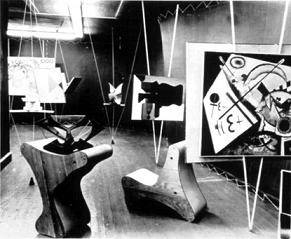
Inside the Art of This Century gallery, 1943. 

Finally, Peggy had to flea from Paris and went to New York. There, she opened a new gallery called Art of This Century. The gallery was beautifully designed, and was made to be just as new and modern as the artworks to be displayed there.

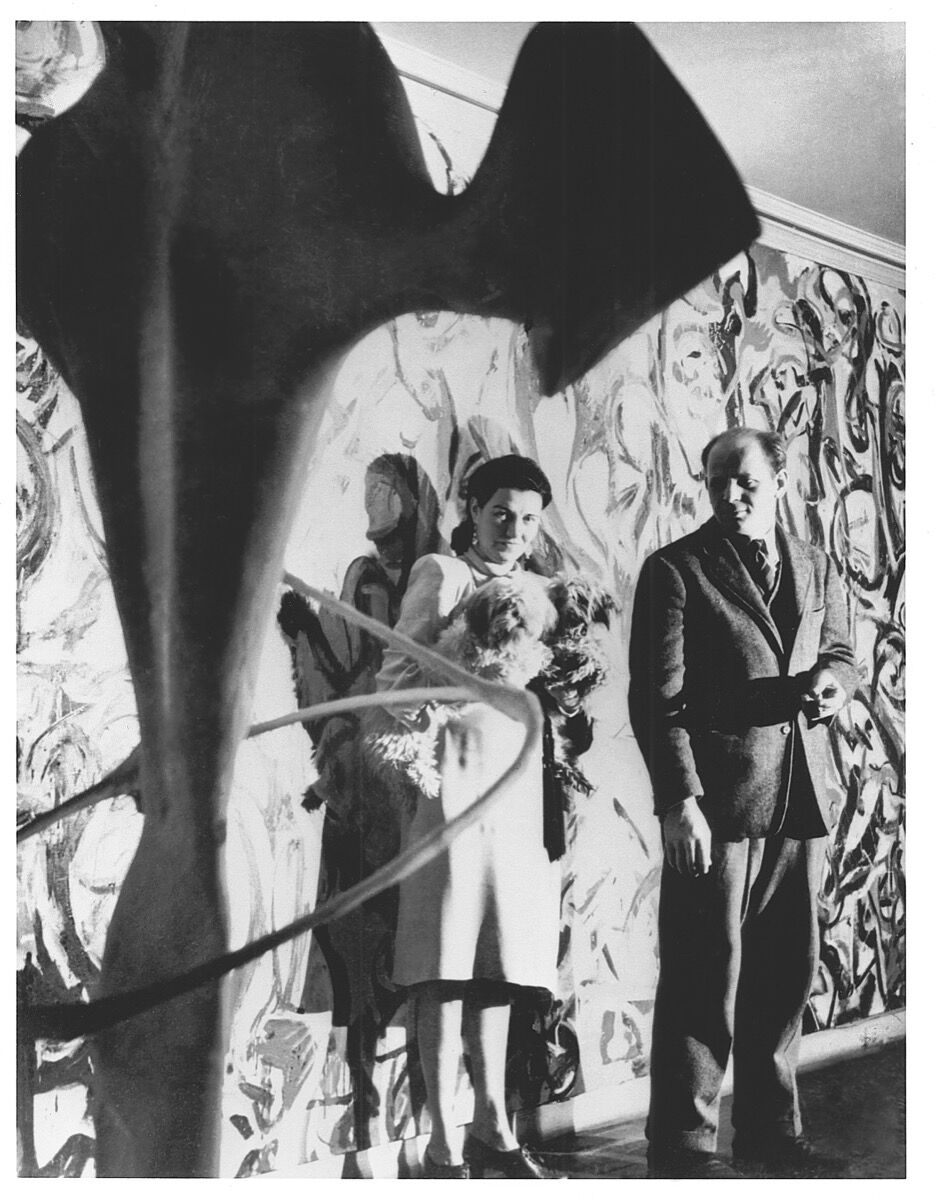
She began to help the careers of American artists, just like she had helped the European ones. Among them was Jackson Pollock. She commissioned his largest ever painting which was 6 metres long!

Peggy Guggenheim and Jackson Pollock in front of Pollock’s Mural, 1943. © Foto George Kargar. Image courtesy of The University of Iowa.
Peggy, Peggy's dogs, and Jackson Pollock in front of his 6 metre long Mural, 1943. 

Pollock and his friends had just begun a new art movement called the American Abstract Expressionists. They were mainly interested in colour. It was really shocking to a lot of people because it didn’t look like the art they were used to. There were no faces or people, just lots of shapes and lots and lots of colour. Peggy was one of their biggest supporters and gave the group some of their first gallery shows. It would go on to become one of the most important American art movements ever, and Peggy was really to thank. 


Image result for peggy guggenheim venice
The Peggy Guggenheim Collection in Venice today. 
After the war, she could finally return to Europe  and she opened a gallery in Venice. This time in the beautiful Palazzo Venier dei Leoni. It was a very very old palace, right on the canal, with water lapping at its sides. It was a gleaming white colour and could be seen by all the boats passing by. Peggy filled it with modern art by Picasso, Magritte, Pollock and Kandinsky. This was the very old building being given new life by this modern art. She gave the American artists their first ever shows in Europe. People all over Europe were shocked and inspired by this new wave of modernism.


By the 1960s, her collections were so impressive that she loaned them out across the world. Her name became associated with some of the most famous artists and artistic movements of the century.

Peggy was known all over the world. Just like the exciting artworks she promoted, she wore really bright colours, huge coats and weirdly shaped glasses, designed by artists who wanted her to wear their artwork. She was always followed around by her two little dogs.

Peggy said she was in love with Venice.
She loved living in Venice and called the beautiful city a ‘living work of art.’ She lived there until her death at the age of 81 and was buried next to her beloved dogs.

The Peggy Guggenheim Collection in Venice is still one of the greatest museums of modern art in the world.


You May Also Like...
Women of Art History: Faith
http://lifeofanarthistorystudent.blogspot.com/2018/09/women-of-art-history-faith.html

2

copyright © . all rights reserved. designed by Color and Code

grid layout coding by helpblogger.com