Women of Art History: Peggy.


Peggy Guggenheim. 1898- 1979. America. 
Patron, collector and gallery owner.
How many artists can you name? Chances are, you'll have named many more men than women. From the moment we are children, most of the artists and artworks we are exposed to are created by or about men. It's time to rebalance the scales and open up the artistic 'canon', introducing more women and ethnic minorities into the widely known narrative of art history. Here, I'll be trying to do just that in the style of a children's story, introducing you to one more woman from art and art history who, until now, you might not have known. 

Once upon a time, there was a girl called Peggy Guggenheim who lived in New York. Her dad had just died in a tragic accident on a ship called the Titanic. He left his daughter a lot of money which made her very wealthy. But Peggy wasn’t interested in living a life of luxury surrounded by riches. Instead, she wanted to be around the exciting new art movements that were popping up all over Europe.

So, when she was twenty she moved to Paris where lots of young artists, musicians and writers were living. If you were interested in art, it was the place to be! Sure enough, Peggy met and became friends with lots of artists. Some of these friends would go on to be very famous, such as Man Ray and Marcel Duchamp.

Add caption
After spending so much time with all of these artists, Peggy became a real expert on the new art being made in Europe. She knew that if she opened a gallery and showed the art she liked, people would want to come visit and see what Peggy had to say about what was important in the art world.

In 1938, she opened her first gallery of modern art in London. She showed a lot of artwork by her friends. Lots of people visited and were excited by what they saw. Everything in Peggy’s gallery was special. This was one of the first galleries to show modern art in London. It was so different from everything they had seen before. For example, she let Vasily Kandinsky have his first show at her gallery, and people were amazed! He used lots of shapes and splodges of paint and clashing, bright colours. Peggy showed London: this is art now.

White Cross, Vasily Kandinsky, 1922.  

After her success in London, she decided to start a museum instead, this time in Paris. The difference between a gallery and a museum was important because modern art was very new and revolutionary, and often quite shocking. Putting it in a museum would make it seem historical and like it wasn’t just a passing craze, it was there to stay. This ‘modern museum’ idea was one of the first of its kind.

She knew that her name had to be associated with an incredible collection for people to take her seriously as a gallery or museum owner. She needed to have lots and lots of artworks to show everyone. She decided to buy a painting every single day.

In 1938, World War Two broke out. The Nazis were killing Jews in Germany, and as a Jewish woman, Peggy was afraid. Even though she was scared, she wanted to stay in Europe as long as she could so that she could buy some of the amazing artworks that were being made there. She stayed in Paris right up until the Germans were approaching, just so that she could seal a deal she was working on with Brancusi.
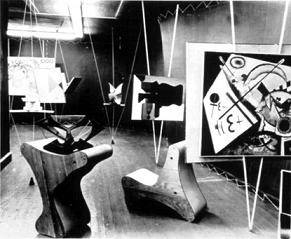
Image result for peggy guggenheim art of this century
Inside the Art of This Century gallery, 1943. 

Finally, Peggy had to flea from Paris and went to New York. There, she opened a new gallery called Art of This Century. The gallery was beautifully designed, and was made to be just as new and modern as the artworks to be displayed there.

She began to help the careers of American artists, just like she had helped the European ones. Among them was Jackson Pollock. She commissioned his largest ever painting which was 6 metres long!
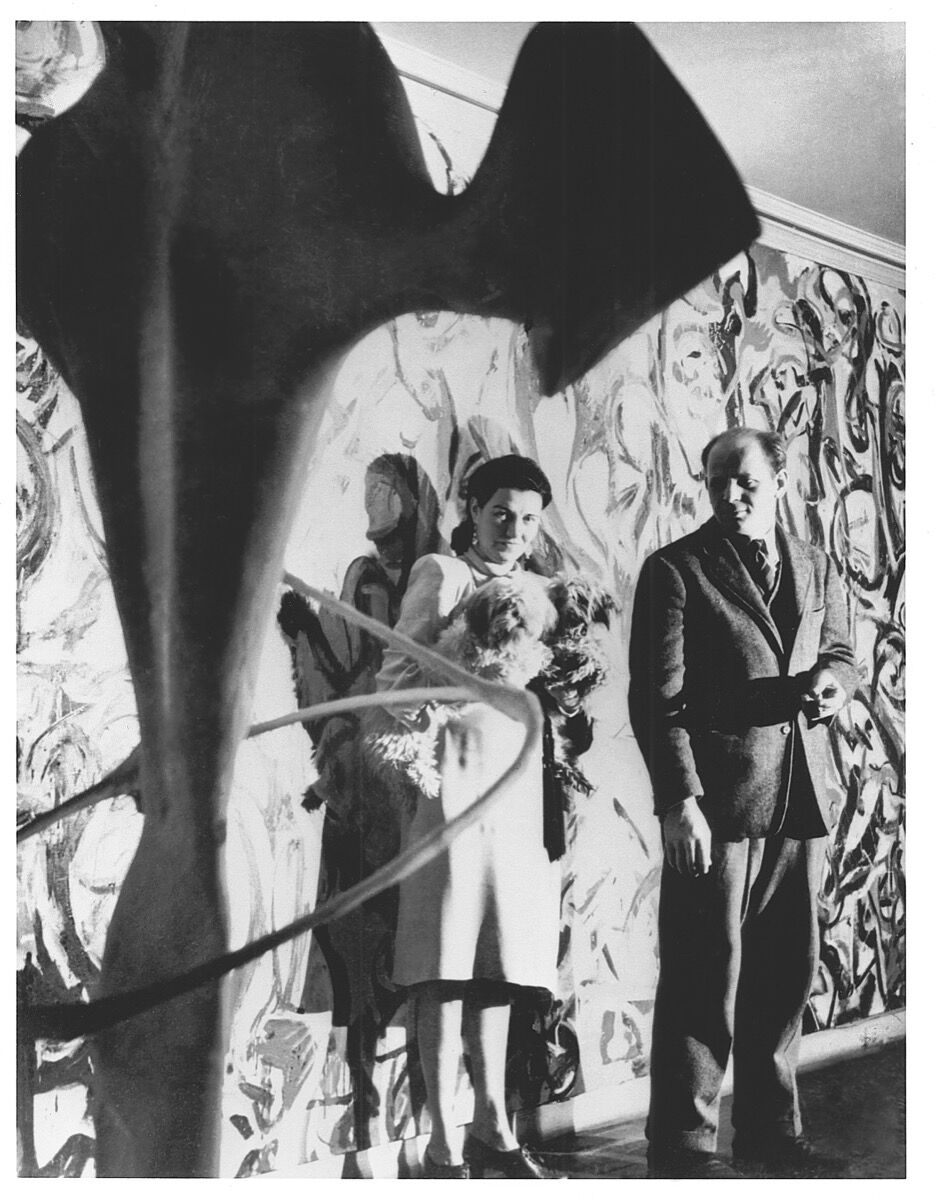
Peggy Guggenheim and Jackson Pollock in front of Pollock’s Mural, 1943. © Foto George Kargar. Image courtesy of The University of Iowa.
Peggy, Peggy's dogs, and Jackson Pollock in front of his 6 metre long Mural, 1943. 

Pollock and his friends had just begun a new art movement called the American Abstract Expressionists. They were mainly interested in colour. It was really shocking to a lot of people because it didn’t look like the art they were used to. There were no faces or people, just lots of shapes and lots and lots of colour. Peggy was one of their biggest supporters and gave the group some of their first gallery shows. It would go on to become one of the most important American art movements ever, and Peggy was really to thank. 


Image result for peggy guggenheim venice
The Peggy Guggenheim Collection in Venice today. 
After the war, she could finally return to Europe  and she opened a gallery in Venice. This time in the beautiful Palazzo Venier dei Leoni. It was a very very old palace, right on the canal, with water lapping at its sides. It was a gleaming white colour and could be seen by all the boats passing by. Peggy filled it with modern art by Picasso, Magritte, Pollock and Kandinsky. This was the very old building being given new life by this modern art. She gave the American artists their first ever shows in Europe. People all over Europe were shocked and inspired by this new wave of modernism.


By the 1960s, her collections were so impressive that she loaned them out across the world. Her name became associated with some of the most famous artists and artistic movements of the century.

Peggy was known all over the world. Just like the exciting artworks she promoted, she wore really bright colours, huge coats and weirdly shaped glasses, designed by artists who wanted her to wear their artwork. She was always followed around by her two little dogs.

Peggy said she was in love with Venice.
She loved living in Venice and called the beautiful city a ‘living work of art.’ She lived there until her death at the age of 81 and was buried next to her beloved dogs.

The Peggy Guggenheim Collection in Venice is still one of the greatest museums of modern art in the world.


You May Also Like...
Women of Art History: Faith
http://lifeofanarthistorystudent.blogspot.com/2018/09/women-of-art-history-faith.html

2

Women of Art History: Faith


Faith Ringgold. 1930-. America. 
Artist and Activist. 

How many artists can you name? Chances are, you'll have named many more men than women. From the moment we are children, most of the artists and artworks we are exposed to are created by or about men. It's time to rebalance the scales and open up the artistic 'canon', introducing more women and ethnic minorities into the widely known narrative of art history. Here, I'll be trying to do just that in the style of a children's story, introducing you to one more woman from art and art history who, until now, you might not have known. 

Once upon a time, there was a little girl raised in an area full of creativity and music. Faith Ringgold grew up in Harlem, New York in the 1930s, when it was a vibrant and exciting arts scene. Faith struggled with chronic asthma when she was little, so turned to art. Crayons were her favourite. Apart from all the young artists and musicians living around her, however, Faith didn't have many famous artists to look up to who were like her. Faith was African-American, and there were hardly any female artists in her school books, and even fewer black artists. She decided she'd have to forge her own path. 

Add caption

When she was younger, Faith tried to show her artwork to gallery dealers but they would look at her legs and not her art. They only saw her as a black woman, and not as an artist. She knew she’d have to keep trying.

Faith tried to study art at college, but the college wouldn't let her because she was a woman. She had to study art education instead but the whole time she was learning and teaching she was always inspired to create art. She wanted to use the issues around her in her artworks, the issues of racism and sexism that she encountered every day. Finally, in 1973, she left teaching to pursue what she really loved. 

Add caption

In the 1970s, black and white women were divided over differences in equality. Back then, feminism was seen as a white woman's cause, only helping white, middle class women to achieve a better life. Black women felt they had to fight for their own causes because their problems were so different. Faith was one of the first to think that feminism should be for both white and black women. Some black people saw her as a traitor, but Faith became very vocal about the need for equality in the art world. Racial equality and female equality. 

Although Faith was a really rounded artist who could paint and sculpt, she became most famous for her quilts. Quilts aren't just something to throw on top of your duvet, but are a really interesting art-form! They are important because quilts deal with issues of race and gender. Historically, women weren't always allowed to learn how to paint and were taught to sew instead, so quilt-making was seen as a 'woman's art, and not as important as men's painting. Quilts were also hugely important for African-American slaves in the 1800s. They made quilts with pictures on to show stories. Faith took this historical idea and made it new and political. 

Image result for faith ringgold aunt jemima
Whose Afraid of Aunt Jemima? Faith Ringgold, 1983. 

Faith’s first quilt told a story about Aunt Jemima, who was a made-up Black woman used in advertising for a pancake mix. In adverts for the pancakes, people thought Jemima was fat, ugly and silly, and completely obedient to her white masters. In Faith’s story, she wanted to ‘rewrite her life.’ She made a new Aunt Jemima, one who was a smart businesswoman and had a family of her own. In the quilt, Jemima is surrounded by other black women, all dressed in rich clothes, and not the apron shown in the pancake advert.

Image result for faith ringgold tar beach
Tar Beach, Faith Ringgold, 1988. 

Faith's best known story-quilt was called Tar Beach. It showed a black family sitting on a rooftop. The little girl, Cassie, looked up at the stars and believed she could fly. Cassie thought "I am free to go wherever I want to for the rest of my life." Faith wanted to give young black girls in America something she never really had, a role model to look up to, to tell them they really could do whatever they wanted. 

Faith was also a founder of Where We At which created exhibitions for black, female artists who weren't getting the recognition they deserved elsewhere. Faith said she wanted to give black women a 'taste of the American dream,' the feeling that they could and would achieve success, opportunity and equality. 

Nowadays, some of the things Faith was fighting for seem normal. Most people realise feminism is for everyone. But Faith's work is still important, showing us that art can be powerful and change people's minds. 

Faith's moved on quite a bit from crayons, now, and her artworks are on display all over the world. Faith is living happily ever after in New Jersey.


Add caption

You May Also Like...


Women of Art History: Peggy
http://lifeofanarthistorystudent.blogspot.com/2018/09/women-of-art-history-peggy.html

1

Review: Uncomfortable Art Tours


n

What do a South Sea coat of arms, a kangaroo and Elizabeth I all have in common? They all play a part in the complex narrative of Britian’s Empire and are all exhibited in the Queen’s House, Greenwich without any labels to explain their relevance within the history of colonialism.


South Sea Company Coat of Arms 


With her Uncomfortable Art Tours Alice Procter attempts to redress this narrative, exposing and analysing such moral gaps within the art galleries and public collections in England. With a background in postcolonial art practice and material culture, Procter provides an accessible route into British colonial history through visual artefacts. Her unofficial tours currently run at six sites: the National Gallery, National Portrait Gallery, British Museum, Victoria and Albert Museum, Tate Britain and the Queen’s House. On each tour, Procter skilfully navigates her way through British art history, aiming to expose and ‘unravel the role colonialism played in shaping and funding a major national collection.’ 


Alice Procter leads a fascinating and challenging tour 

 
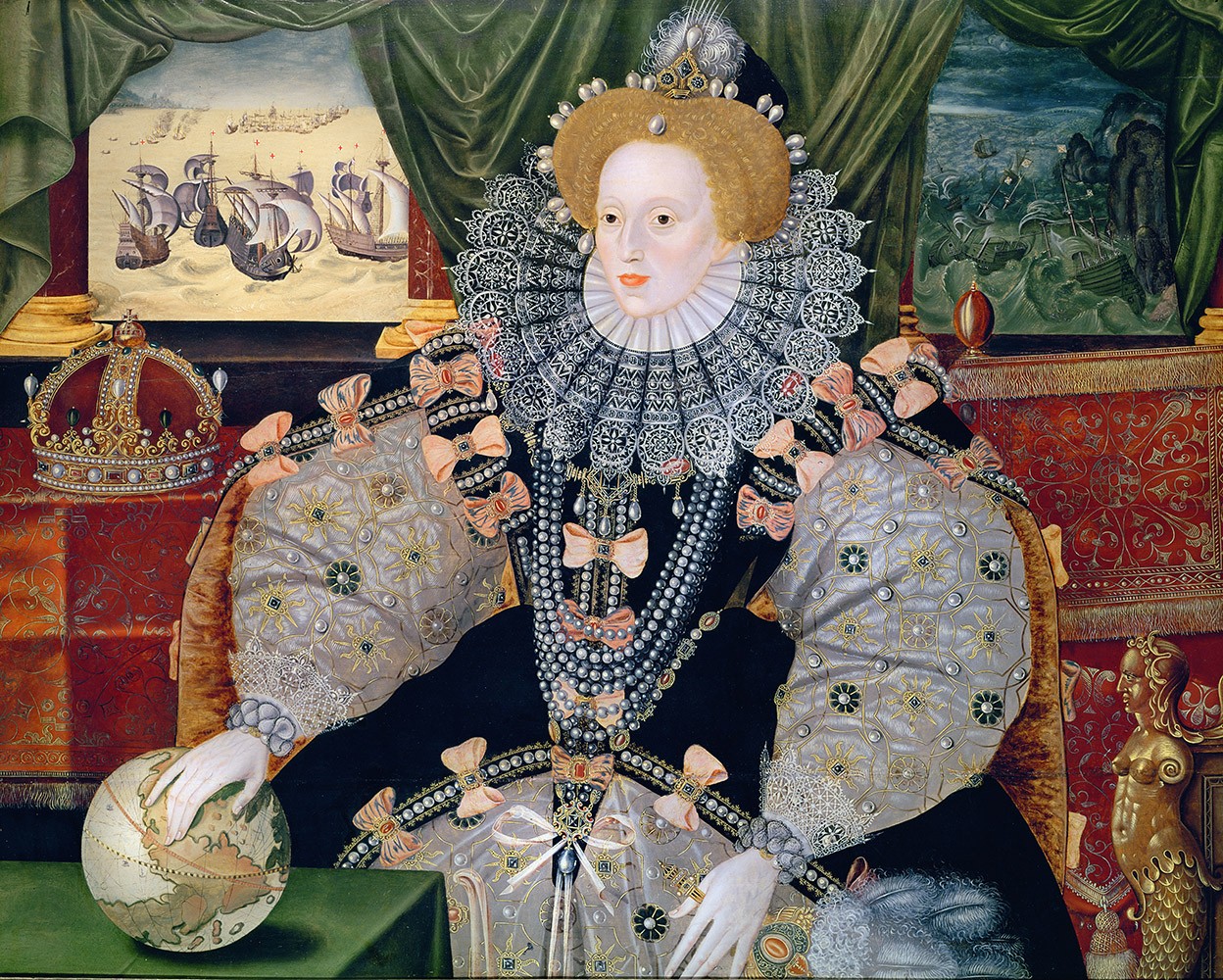
The relevance of her tours can perhaps nowhere else be as greatly felt as at the Queen’s House whose prize artwork is a painting of Elizabeth I known as the ‘Armada Portrait.’ The Tudor queen sits resplendent in her finery and jewels with one hand placed firmly on a globe. Behind her are windows showing English boats on calm seas and Spanish ships floundering in a storm. The painting was commissioned to commemorate the failed invasion attempt on England by the Spanish Armada in 1588, but ultimately can be read as a symbol of English imperial aspirations. With Elizabethan maritime victory came England, and subsequently, Britain’s involvement in the slave trade. Sir John Hawkins, the founder of the Royal Navy is also thought to be the first English trader to benefit from slavery.

Image result for armada portrait greenwich
One of the main attractions in the Queen's House, the Armada Portrait of Elizabeth I  

This is a prominent theme in the Uncomfortable Art Tour of the Queen’s House. Where there was English success and power, there were consequences for indigenous people, a side of English history that is not yet fully acknowledged.

Paintings of Australia in the 'Enlightenment' room were largely inaccurate but are not labelled 
Whereas art lovers may worry that this approach to galleries would ruin the enjoyment of the collection, the reality is quite different. Procter’s insights really enrich the experience of the gallery. A large coat of arms of the South Sea Company could have easily been an overlooked relic. Instead, Procter questions why there is a figure of a fisherman when the company was not in fact involved in the fishing but the slave trade. Perhaps the company used this figure as a euphemism, a tongue-in-cheek reference to their dealings in slavery, catching people rather than fish. It is a fascinating – and unsettling- insight into the attitudes towards slavery at the time.


In these prints by Stradanus, Native Americans are shown as cannibals. The gallery has not signposted this.

Procter doesn’t simply analyse the artworks but also their very display. Highlighting countless harmful depictions of indigenous peoples during the explorations of America and Australia, Procter questions why they are displayed without explanation or criticism by the gallery. In one particularly shocking example, in ‘The Discovery of America’ print, the Native Americans are depicted as cannibals. Alongside this print are simply the words ‘these two sets of prints celebrate the inventions and discoveries that shaped early modern Europe.’ In another room, largely fantastical paintings of Australia by the Europeans in 19th century are accompanied by paintings of scientific advancement and a sculpture of Sir Isaac Newton. These curatorial choices are subtle, yet arguably play into the rhetoric of the European man as simply a curious scientist, without regards for the larger impact on indigenous people. Moreover, the word ‘explorer’ is used often, which Procter says paints the colonialists as harmless adventurers.

Complex paintings of colonialism are contextualised next to scientific advancements and Sir Isaac Newton 

Of course, these issues are often not clear cut, and Procter encourages debate within her tours. However, it is clear on which side of the argument her tours sit. Under the name ‘The Exhibitionist’, Procter sells badges with the phrase ‘Display It Like You Stole It’. Procter’s tours do not call for the complete overthrow of the art gallery as we know it, but for more consideration and explanation in displays and exhibitions, with a more nuanced attitude to British history.


The 'Display It Like You Stole It' badge

Whereas many galleries across the west are now recognising their responsibility, the labels of the Queen’s House remain remarkably silent on the matter. It may, be uncomfortable, but this reassessment of British galleries are a necessary in understanding the agenda behind many of our best known works of art, and our history, at the same time, is brought to life and becomes more accessible to us as a result.

You May Also Like...
http://lifeofanarthistorystudent.blogspot.com/2017/05/flames-of-perseverance.html


0

Women Of Art History: Isabella


Isabella d'Este. 1474-1539. Italy. 
Patron and Collector. 
­­How many artists can you name? Chances are, you'll have named many more men than women. From the moment we are children, most of the artists and artworks we are exposed to are created by or about men. It's time to rebalance the scales and open up the artistic 'canon', introducing more women and ethnic minorities into the widely known narrative of art history. Here, I'll be trying to do just that in the style of a children's story, introducing you to one more woman from art and art history who, until now, you might not have known. 

Once upon a time, a little girl loved studying. Her name was Isabella d'Este and she was fascinated by ancient history. She learnt all about the ancient Romans and the Greeks and even learnt how to speak Latin and Greek. Because she was so clever and interested, she started speaking to ambassadors who came to visit her parents, who were the Duke and Duchess of Naples in Italy. Even though she was a young woman, she could talk to all these important people about ancient plays and poems, and they were all impressed by her. She realised then, that to get people to take her seriously, even though they thought women were silly, she would have to use her greatest powers: her wit and intellect. 

Add caption

Isabella married Francesco Gonzaga and became the noble Marchesa of Mantua, but even though her husband was seen as important and powerful, there wasn't much for Isabella to do. As a woman and wife, she was expected to stay at home and make sure everything looked pretty for Francesco and his friends. But Isabella wasn't content with that and knew that she would have to prove how clever and valuable she could be. 

Women normally arranged for pretty artworks to be brought into their homes to decorate the place. They were not expected to be that complicated, and were often a simple religious painting. Isabella thought that she would buy more complex and impressive artworks in her house, and show the visiting men -ambassadors, noblemen, kings - that she was more than they had assumed. 

Isabella wrote thousands of letters to the famous artists of her time. You can still read them today.

Isabella began writing to the famous artists of her time. These are big names that you probably know already. There were letters to Leonardo da Vinci, Mantegna, Raphael, Titian and many more. Isabella didn't ask for a painting, she told them what she wanted. She knew that what was in the painting would be important, because when visitors came to her house they would know she had bought the painting. Just like speaking Latin showed how clever she was, and how interested she was in ancient history, these paintings showed the world that Isabella understood complex mythological stories and ancient symbolism. 

Until then, it was assumed only men would understand these paintings because a lot of the stories were related to ancient tales about battles and had lots of hidden meanings you had to study to understand. Visitors were shocked when they realised these paintings had been made not for Francesco, but for his wife Isabella. 
 
The Triumph of the Virtues, Andrea Mantegna, 1502. 
In one painting, Isabella told Mantegna to paint an old story all about a woman, Minerva, expelling wickedness from her garden. When visitors saw this painting, they understood that Isabella was comparing herself to Minerva. She was a powerful woman in control of her home. 

When Francesco died, it became even more important for Isabella to show her intellect and seize power in the only ways she could. She didn't want men saying she wasn't fit to rule Mantua. Not only did she buy paintings, but she also collected gems, jewels, medals and ancient sculptures. All of these things had only previously been collected by men. She had beautiful studio rooms built to show off her collections. Because they were so impressive, important meetings began to be held in her studios and from there, she could get involved in political discussions. 

A ring from the 1500s, thought to have a portrait of Isabella on it, made of pearl.  
She used her art collecting and patronage to prove women could do more than just sit at home. She proved she could make huge financial decisions and tell very famous artists what to do. Everyone was so impressed by her that she was made regent, which meant she was in charge of Mantua until her son was old enough to take over. 

Isabella became known as 'The First Lady of the Renaissance' and was one of the most influential art patrons for centuries. The Renaissance was a time when men became really involved with art and history, and so Isabella was really special for being recognised as a valuable woman in an area dominated by men. 

For the rest of her life, important men such as the Pope himself were filled with respect for her. She showed just how important art could be as a tool to seize power, and how to prove your worth, individuality and intelligence even when you don't have many ways to do so.

You May Also Like...
Women of Art History: Faith
http://lifeofanarthistorystudent.blogspot.com/2018/09/women-of-art-history-faith.html


2

copyright © . all rights reserved. designed by Color and Code

grid layout coding by helpblogger.com