Review: Uncomfortable Art Tours


n

What do a South Sea coat of arms, a kangaroo and Elizabeth I all have in common? They all play a part in the complex narrative of Britian’s Empire and are all exhibited in the Queen’s House, Greenwich without any labels to explain their relevance within the history of colonialism.


South Sea Company Coat of Arms 


With her Uncomfortable Art Tours Alice Procter attempts to redress this narrative, exposing and analysing such moral gaps within the art galleries and public collections in England. With a background in postcolonial art practice and material culture, Procter provides an accessible route into British colonial history through visual artefacts. Her unofficial tours currently run at six sites: the National Gallery, National Portrait Gallery, British Museum, Victoria and Albert Museum, Tate Britain and the Queen’s House. On each tour, Procter skilfully navigates her way through British art history, aiming to expose and ‘unravel the role colonialism played in shaping and funding a major national collection.’ 


Alice Procter leads a fascinating and challenging tour 

 
The relevance of her tours can perhaps nowhere else be as greatly felt as at the Queen’s House whose prize artwork is a painting of Elizabeth I known as the ‘Armada Portrait.’ The Tudor queen sits resplendent in her finery and jewels with one hand placed firmly on a globe. Behind her are windows showing English boats on calm seas and Spanish ships floundering in a storm. The painting was commissioned to commemorate the failed invasion attempt on England by the Spanish Armada in 1588, but ultimately can be read as a symbol of English imperial aspirations. With Elizabethan maritime victory came England, and subsequently, Britain’s involvement in the slave trade. Sir John Hawkins, the founder of the Royal Navy is also thought to be the first English trader to benefit from slavery.
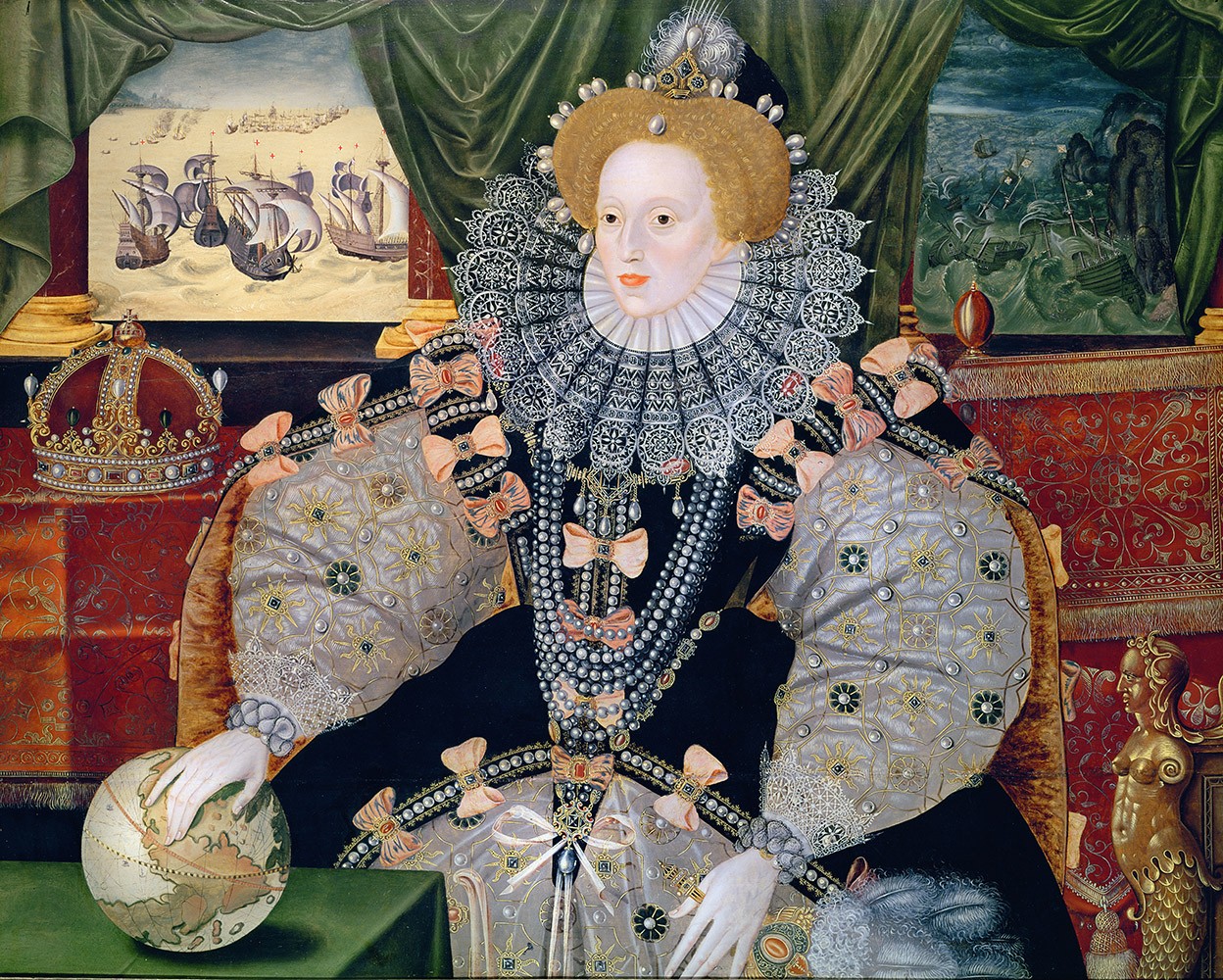
Image result for armada portrait greenwich
One of the main attractions in the Queen's House, the Armada Portrait of Elizabeth I  

This is a prominent theme in the Uncomfortable Art Tour of the Queen’s House. Where there was English success and power, there were consequences for indigenous people, a side of English history that is not yet fully acknowledged.

Paintings of Australia in the 'Enlightenment' room were largely inaccurate but are not labelled 
Whereas art lovers may worry that this approach to galleries would ruin the enjoyment of the collection, the reality is quite different. Procter’s insights really enrich the experience of the gallery. A large coat of arms of the South Sea Company could have easily been an overlooked relic. Instead, Procter questions why there is a figure of a fisherman when the company was not in fact involved in the fishing but the slave trade. Perhaps the company used this figure as a euphemism, a tongue-in-cheek reference to their dealings in slavery, catching people rather than fish. It is a fascinating – and unsettling- insight into the attitudes towards slavery at the time.


In these prints by Stradanus, Native Americans are shown as cannibals. The gallery has not signposted this.

Procter doesn’t simply analyse the artworks but also their very display. Highlighting countless harmful depictions of indigenous peoples during the explorations of America and Australia, Procter questions why they are displayed without explanation or criticism by the gallery. In one particularly shocking example, in ‘The Discovery of America’ print, the Native Americans are depicted as cannibals. Alongside this print are simply the words ‘these two sets of prints celebrate the inventions and discoveries that shaped early modern Europe.’ In another room, largely fantastical paintings of Australia by the Europeans in 19th century are accompanied by paintings of scientific advancement and a sculpture of Sir Isaac Newton. These curatorial choices are subtle, yet arguably play into the rhetoric of the European man as simply a curious scientist, without regards for the larger impact on indigenous people. Moreover, the word ‘explorer’ is used often, which Procter says paints the colonialists as harmless adventurers.

Complex paintings of colonialism are contextualised next to scientific advancements and Sir Isaac Newton 

Of course, these issues are often not clear cut, and Procter encourages debate within her tours. However, it is clear on which side of the argument her tours sit. Under the name ‘The Exhibitionist’, Procter sells badges with the phrase ‘Display It Like You Stole It’. Procter’s tours do not call for the complete overthrow of the art gallery as we know it, but for more consideration and explanation in displays and exhibitions, with a more nuanced attitude to British history.


The 'Display It Like You Stole It' badge

Whereas many galleries across the west are now recognising their responsibility, the labels of the Queen’s House remain remarkably silent on the matter. It may, be uncomfortable, but this reassessment of British galleries are a necessary in understanding the agenda behind many of our best known works of art, and our history, at the same time, is brought to life and becomes more accessible to us as a result.

You May Also Like...
http://lifeofanarthistorystudent.blogspot.com/2017/05/flames-of-perseverance.html


0

Women Of Art History: Isabella


Isabella d'Este. 1474-1539. Italy. 
Patron and Collector. 
­­How many artists can you name? Chances are, you'll have named many more men than women. From the moment we are children, most of the artists and artworks we are exposed to are created by or about men. It's time to rebalance the scales and open up the artistic 'canon', introducing more women and ethnic minorities into the widely known narrative of art history. Here, I'll be trying to do just that in the style of a children's story, introducing you to one more woman from art and art history who, until now, you might not have known. 

Once upon a time, a little girl loved studying. Her name was Isabella d'Este and she was fascinated by ancient history. She learnt all about the ancient Romans and the Greeks and even learnt how to speak Latin and Greek. Because she was so clever and interested, she started speaking to ambassadors who came to visit her parents, who were the Duke and Duchess of Naples in Italy. Even though she was a young woman, she could talk to all these important people about ancient plays and poems, and they were all impressed by her. She realised then, that to get people to take her seriously, even though they thought women were silly, she would have to use her greatest powers: her wit and intellect. 

Add caption

Isabella married Francesco Gonzaga and became the noble Marchesa of Mantua, but even though her husband was seen as important and powerful, there wasn't much for Isabella to do. As a woman and wife, she was expected to stay at home and make sure everything looked pretty for Francesco and his friends. But Isabella wasn't content with that and knew that she would have to prove how clever and valuable she could be. 

Women normally arranged for pretty artworks to be brought into their homes to decorate the place. They were not expected to be that complicated, and were often a simple religious painting. Isabella thought that she would buy more complex and impressive artworks in her house, and show the visiting men -ambassadors, noblemen, kings - that she was more than they had assumed. 

Isabella wrote thousands of letters to the famous artists of her time. You can still read them today.

Isabella began writing to the famous artists of her time. These are big names that you probably know already. There were letters to Leonardo da Vinci, Mantegna, Raphael, Titian and many more. Isabella didn't ask for a painting, she told them what she wanted. She knew that what was in the painting would be important, because when visitors came to her house they would know she had bought the painting. Just like speaking Latin showed how clever she was, and how interested she was in ancient history, these paintings showed the world that Isabella understood complex mythological stories and ancient symbolism. 

Until then, it was assumed only men would understand these paintings because a lot of the stories were related to ancient tales about battles and had lots of hidden meanings you had to study to understand. Visitors were shocked when they realised these paintings had been made not for Francesco, but for his wife Isabella. 
 
The Triumph of the Virtues, Andrea Mantegna, 1502. 
In one painting, Isabella told Mantegna to paint an old story all about a woman, Minerva, expelling wickedness from her garden. When visitors saw this painting, they understood that Isabella was comparing herself to Minerva. She was a powerful woman in control of her home. 

When Francesco died, it became even more important for Isabella to show her intellect and seize power in the only ways she could. She didn't want men saying she wasn't fit to rule Mantua. Not only did she buy paintings, but she also collected gems, jewels, medals and ancient sculptures. All of these things had only previously been collected by men. She had beautiful studio rooms built to show off her collections. Because they were so impressive, important meetings began to be held in her studios and from there, she could get involved in political discussions. 

A ring from the 1500s, thought to have a portrait of Isabella on it, made of pearl.  
She used her art collecting and patronage to prove women could do more than just sit at home. She proved she could make huge financial decisions and tell very famous artists what to do. Everyone was so impressed by her that she was made regent, which meant she was in charge of Mantua until her son was old enough to take over. 

Isabella became known as 'The First Lady of the Renaissance' and was one of the most influential art patrons for centuries. The Renaissance was a time when men became really involved with art and history, and so Isabella was really special for being recognised as a valuable woman in an area dominated by men. 

For the rest of her life, important men such as the Pope himself were filled with respect for her. She showed just how important art could be as a tool to seize power, and how to prove your worth, individuality and intelligence even when you don't have many ways to do so.

You May Also Like...
Women of Art History: Faith
http://lifeofanarthistorystudent.blogspot.com/2018/09/women-of-art-history-faith.html


2

We Got Kittens! Week 1


Yep, you heard correctly, folks. We – the family renowned for never having pets, not even a goldfish- have got pets. Two of them to be precise. Meet Pink and Floyd, our 9 week old kittens.

Pink and Floyd

For all of my 20 years of life, my parents have resolutely vowed to never let us have pets because they were sure they’d end up doing all the work once the novelty wore off. This is entirely unjust. I bought a collar and lead for my Bear Factory dog and dragged it around the kitchen floor every day for walkies. My favourite Barbie ever was the one where her dog poos and you pick up the little blobs with a magnetic poo shovel. To this day, I will always ask my friends if I can pick up the poo when we take their dogs for a walk. If that isn’t commitment I don’t know what is. (Please note: the theme here is how committed I am to pets, and not how obsessed I am with dog poo.)

It quickly became clear they now owned our house.
Anyway, the ‘rents finally gave in when our family friends’ cat had a litter and two adorable kittens were up for grabs. Here’s a run down of everything I’ve learned this first week.

PetsAtHome is my new shopping obsession. Who knew there was this whole elite world of pets accessories that I’ve never been apart of? It was like going to Primark for the first time and realising just how much money you could waste on crap in one single shop. When I went to get supplies the day before the kittens arrived, I felt like, for want of a better phrase, the cat that got the cream. There is so much to choose from! I had written on my list ‘scratch post’ and did not expect to be confronted with an entire aisle of scratch palaces. There was one installation with a hammock and an array of tunnels that was genuinely £100. I’ll admit it took me a few seconds to convince myself not to get it. I mean, they can’t have a fancier bedroom than I do. I did buy an adorable set of kitten toys but was annoyed at myself for automatically going for the pink set. Next time I go I’m definitely getting the blue ones, no traditional gender roles for my kittens, no thank you.

The Bishops Avenue of the cat world. 


Writing their names on forms is adorable. Whether it be your new PetsAtHome loyalty card or signing them up to the vet, writing Pink and Floyd in the name box never gets old.

Getting them in the carry case is traumatic. Especially when there’s two of them. Pink is by far the friendlier one and was quite happy to be plopped in. Floyd, on the other hand, went absolutely mental because she hates being touched, let alone shoved in a cage. Her hissing, biting and scratching eventually set Pink off too.  (Trying to think of a metaphor here I've come up with Ms Trunchbull's spikey cupboard in Matilda which is a bit rogue but I'm shoving it in here anyway). 


Sharing does not seem to be caring. Despite the fact the sisters clearly love each other a lot (they nap cuddled up together which is 15/10 on the adorable ratings), they are unable to share food. Well, more precisely, Floyd is quite happy to share but Pink, on the other paw, growls whenever Floyd tries to eat next to her. Pink also seems to never lose her appetite and will eat when: she feels happy, she feels stressed, she sees Floyd eating, she passes the food and thinks ooh is it that time again? 


Much more interested in the stairs than they are in me

I know this is pretty much a known fact but everything smells. I knew it in theory, but the real stench of a room where they eat little cubes of fish and meat and then proceed to poo it out a metre away is actually hard to fully describe.

I’m a psycho mum. Yep, I always thought I’d be chilled, but turns out, I’m the type of mum who will call up the school everyday to check my kids are wearing sun cream, even in winter. I’m genuinely terrified all the time that something bad will happen to them. Even though they are currently just in a few rooms, with no exists, I keep getting into my head they’ve jumped out a –closed- window. The other day I found Pink sleeping but woke her up to check she was still alive.


Fleas are the worst. I didn’t want to believe that my little fluff balls could have actual parasites on them, but after watching them scratch for a few days, the truth was unavoidable. We gave them a pill which makes them scratch loads and then all the fleas fall out. Having to do this then freak them out with the vacuum cleaner was probably equivalent to my mum reassuring me it was for my own good when she had to scrape my scalp for lice everyday in Year 2. Still don't think either of us are over that trauma.


Taking a selfie with a kitten is harder than it seems...

So that’s it for my first week with my kittens. I’ve turned into a nervous wreck. Pink is chilled and cuddly but also potentially has an eating problem. Floyd is still shy and not cuddly but she killed a huge spider the other day in one swipe and ate it so she’s clearly going to be a badass. And scratching for fleas has left them comfortably numb. [1]


[1] Please note, if you don’t get this reference. Look up Pink Floyd before coming to meet our kitties or they’ll be offended.

You May Also Like...
http://lifeofanarthistorystudent.blogspot.com/2017/02/my-first-trip-to-urban-outfitters.html

https://lifeofanarthistorystudent.blogspot.com/2017/03/when-i-cried-in-lakota.html


0

copyright © . all rights reserved. designed by Color and Code

grid layout coding by helpblogger.com